- Custom website design aligns structure, performance, and messaging with real user behavior, creating clearer journeys that support engagement, trust, and meaningful conversion outcomes.
- Strategy-driven design improves scalability, accessibility, search visibility, and security by building intentional systems rather than adapting content to rigid template frameworks.
- Blue Pixel Media delivers custom websites rooted in research, clarity, and long-term growth, helping businesses create digital platforms that evolve with their goals and audience needs.
Businesses invest serious time, energy, and budget into building an online presence. A website often shapes a first impression long before a sales call or consultation ever happens. And first impressions online are fast. Visitors decide within seconds whether to stay or leave.
Yet many organizations still rely on prebuilt templates, assuming convenience equals efficiency. It feels practical. It feels quick. It feels cost-effective.
But quick and strategic are rarely the same thing.
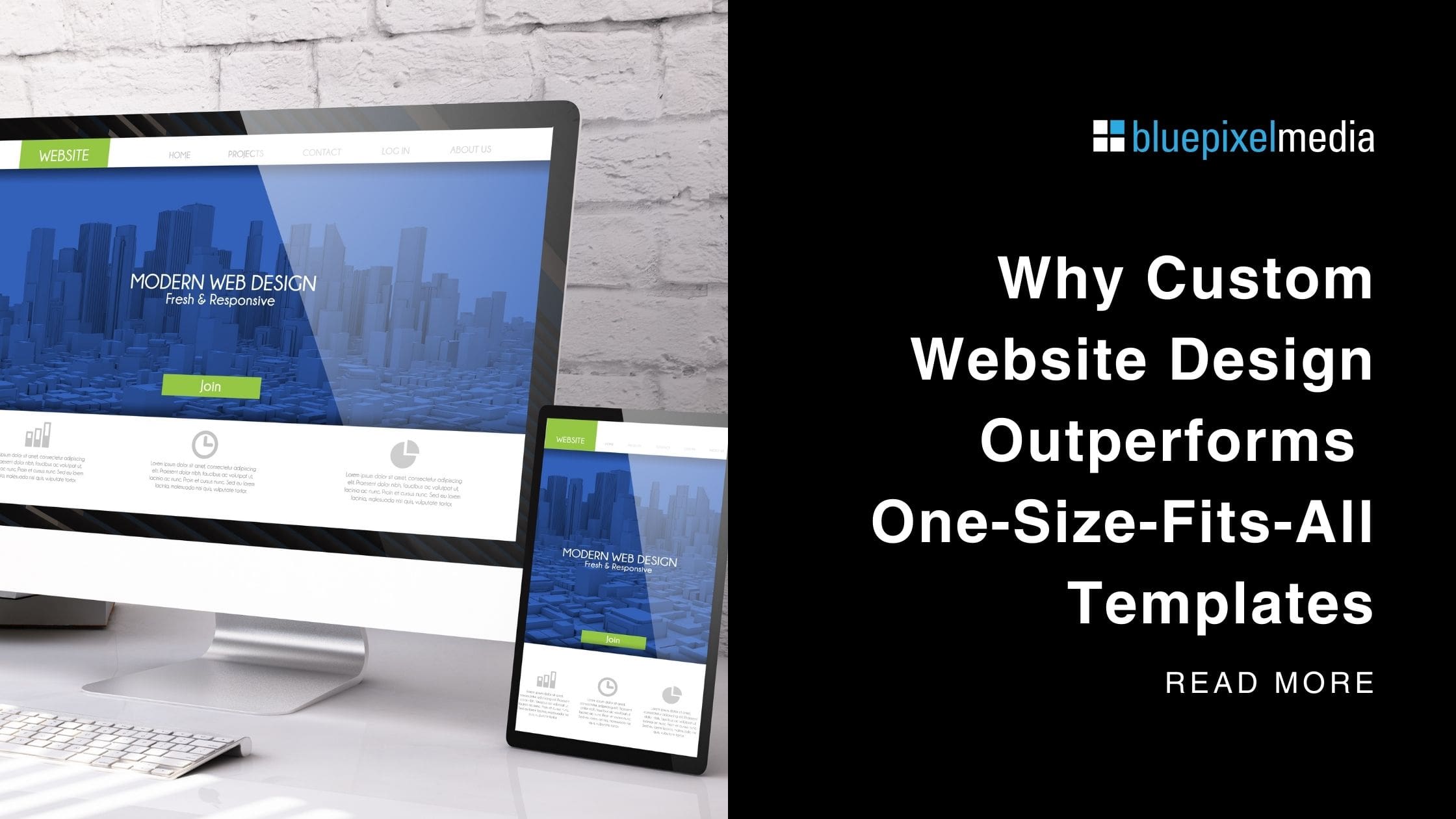
Custom website design consistently outperforms templates because it aligns structure, messaging, user behavior, and performance with specific business goals. Instead of squeezing your brand into a prebuilt box, custom design builds the box around you.
That difference matters more than most businesses realize.
Templates Prioritize Speed Over Strategy
Templates are built to work for everyone. And when something tries to work for everyone, it rarely works perfectly for anyone.
Their layouts, navigation patterns, and content blocks must function reasonably well for countless industries and audiences. That universality becomes their weakness.
A template does not begin with research into your audience’s behavior, decision-making triggers, or expectations. It begins with a generic structure designed to look acceptable across use cases. When a business adopts that structure, it adapts its content and messaging to fit the template rather than designing the experience around user needs.
Custom website design flips that script.
It starts with discovery, audience analysis, and business priorities. Page hierarchy, content flow, and interaction patterns are built intentionally to support how visitors move from curiosity to trust to action. The difference shows in engagement metrics, clarity of messaging, and conversion outcomes.
Strategy first. Layout second. Always.
Brand Identity Suffers Inside Template Constraints
A brand lives in tone, pacing, visual language, and emotional resonance. Templates allow limited control over these elements. Fonts, spacing systems, animations, and layout rules are often locked into rigid frameworks.
You can change the colors. You can swap out the photos.
But underneath, the experience still feels familiar in a way that blends into the background.
Custom design allows a brand to express itself consistently across every interaction. Typography reinforces credibility or warmth. Spacing communicates confidence and clarity. Motion is used sparingly to guide attention rather than distract.
These details may feel subtle individually. Together, they create a cohesive experience that builds recognition and trust.
And recognition matters when someone remembers your website weeks later without struggling to recall the name, that is, design working quietly in your favor.
User Experience Requires Context, Not Assumptions
Templates rely on broad assumptions about how people browse websites. Those assumptions fall short when applied to specific industries.
A professional services firm attracts visitors who want reassurance and clarity.
A healthcare provider attracts visitors who want trust and empathy.
A manufacturing company attracts visitors who want precision and technical depth.
Those journeys look different.
Custom website design responds to real behavior rather than guesses. Designers study how users arrive at the site, what questions they ask first, where hesitation occurs, and what motivates action. Navigation paths are streamlined. Content reduces cognitive load. Forms appear where commitment feels natural.
Visitors feel understood because the site mirrors their mindset instead of forcing them into a generic path.
And when users feel understood, they stay longer.
Performance Optimization Begins at the Foundation
Many templates include features intended to impress a broad audience, even if those features are never used. Sliders. Animations. Scripts layered on top of scripts. The digital equivalent of decorative throw pillows.
All of it adds weight.
Custom design focuses on performance from the beginning. Only necessary features are included. Images serve a purpose. Code is written intentionally. Page structure supports fast rendering across devices.
Search engines prioritize performance signals such as load speed and interaction responsiveness. Visitors do the same. A slow site tests patience, and patience runs short quickly.
A custom website delivers a smoother experience because it is built for purpose, not decoration.
Search Visibility Depends on Structure and Intent
Search engine optimization extends far beyond keywords. Site architecture, internal linking, content hierarchy, and semantic structure all influence visibility.
Templates often force content into predefined layouts that do not align with search intent. Important information gets buried. Heading structures prioritize aesthetics. URL paths follow arbitrary patterns.
Custom website design aligns technical structure with content strategy. Pages are organized around meaningful topics. Headings reflect intent clearly. Internal links distribute authority strategically.
This clarity helps search engines understand relevance. It also helps visitors find what they need without friction.
When structure supports understanding, visibility improves naturally.
Scalability Matters Long After Launch
Businesses evolve. Services expand. Messaging sharpens. New priorities emerge.
Templates often resist growth. Adding new sections can disrupt layouts. Expanding functionality may require complicated workarounds. At some point, the template begins to feel like a cramped office that everyone has outgrown.
Custom design anticipates change.
Modular systems allow expansion without sacrificing consistency. New pages integrate seamlessly. Functionality evolves without breaking performance.
The result is flexibility that protects long-term investment. Instead of rebuilding every few years, the site grows with the business.
Accessibility Requires Intentional Design Choices
Accessibility remains overlooked in many template designs. While some claim compliance, real accessibility requires deliberate planning.
Custom website design integrates accessibility from the beginning. Color contrast supports readability. Navigation works without reliance on a mouse. Typography remains clear across devices.
Accessible design improves usability for everyone. It expands reach, supports ethical digital practices, and strengthens brand credibility.
When clarity improves, engagement follows.
Conversion Strategy Cannot Be Prepackaged
Templates provide default calls to action and suggested button placements. They imply where conversion should happen.
Conversion does not follow a default setting.
It depends on timing, trust, and clarity.
Custom design builds a conversion strategy into the user journey. Messaging addresses hesitation before requesting commitment. Calls to action appear when users feel informed. Visual hierarchy directs attention naturally.
The result is stronger leads and more meaningful inquiries. Visitors arrive at contact forms prepared rather than uncertain.
And prepared visitors convert with confidence.
Security and Maintenance Improve With Custom Builds
Template-based sites often rely heavily on third-party plugins to achieve functionality. Each additional plugin introduces potential vulnerabilities and maintenance complexity.
Custom websites reduce unnecessary dependencies. Core functionality integrates directly into the architecture. Maintenance becomes simpler because developers understand the structure completely.
Ownership and Longevity Protect Investment
Templates connect your website to external frameworks and licensing decisions. Changes in support or compatibility can trigger unexpected redesigns.
Custom design provides autonomy.
The site belongs entirely to the business. Design and functionality evolve according to internal goals rather than third-party updates.
That independence safeguards long-term value.
Custom Design Reflects Respect for the Audience
Visitors recognize effort. A custom website signals professionalism and intentionality. It communicates that the business values clarity and usability.
Templates can look polished. They often feel interchangeable. A custom site feels deliberate. That distinction builds trust before any conversation begins. And trust remains one of the strongest drivers of conversion.
Measuring Success Becomes Clearer and Actionable
Templates restrict experimentation. When layout flexibility is limited, it becomes difficult to determine whether results reflect content quality or structural constraints.
Custom design allows meaningful testing. Analytics data connects directly to intentional layout decisions. Adjustments are guided by evidence rather than guesswork.
Clarity in measurement supports continuous refinement.
And refinement supports growth.
The Long-Term Cost Advantage of Custom Design
Templates appear cost-effective initially. Over time, expenses accumulate through modifications, plugins, performance limitations, and redesign cycles.
Custom website design requires greater upfront investment. It delivers sustained value through performance, scalability, and adaptability.
When viewed as a strategic platform rather than a quick solution, custom design consistently produces stronger returns.
Why Strategy-Driven Design Outperforms Visual Shortcuts
Visual appeal captures attention. Strategy converts it. Templates prioritize surface aesthetics because that sells quickly. Custom design prioritizes purpose.
Every element serves a function. Color supports emotion and readability. Layout supports flow. Content supports understanding.
Nothing exists without intention. That alignment transforms a website into a functional extension of the business rather than a digital brochure collecting dust in a corner of the internet.
Choosing Custom Design as a Commitment to Growth
Selecting a custom website design reflects confidence in a long-term vision. It acknowledges that growth requires adaptability and meaningful audience connection.
Rather than fitting into predefined boxes, custom design creates space for authentic communication and strategic evolution.
That freedom leads to stronger relationships, clearer messaging, and measurable results.
When businesses treat their website as a living platform rather than a static page, custom design becomes the logical foundation.
Blue Pixel Media delivers custom websites rooted in research, clarity, and long-term growth. Partner with a team that designs digital platforms around your goals, your audience, and your future, creating experiences that perform as powerfully as they look.